

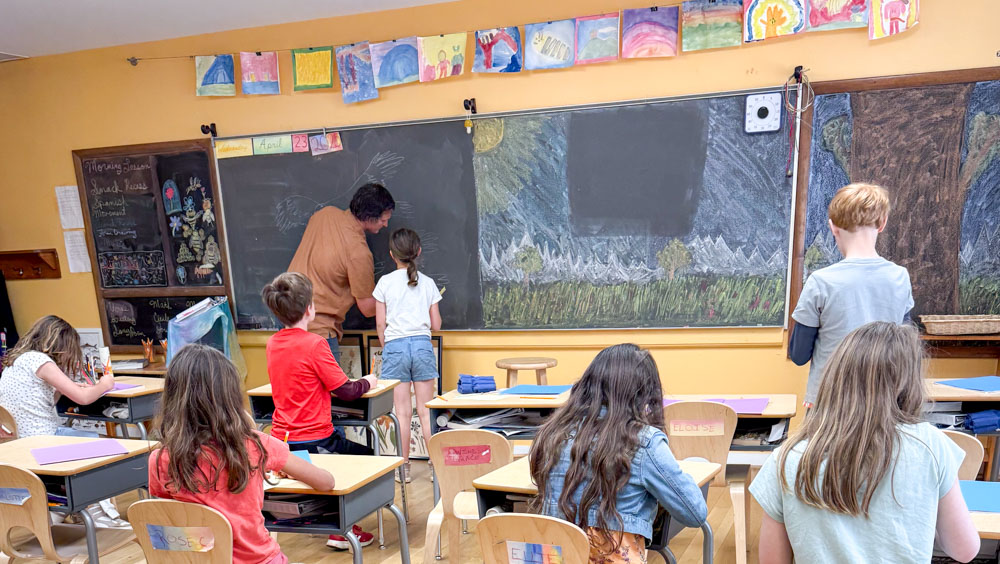
Waldorf Schools have been screen-free always. Our classrooms contain no smart-screens or televisions, and computers are introduced in middle school for specific projects. When all the world is more and more screen-based, why do Waldorf schools continue on this track?
The answer begins with another question: What do children need most during each stage of development?
Advocates of educational technology often point to the vast amount of information available through screens. With a smartphone in hand, we can find an answer to nearly any question within seconds and with AI we can even get help figuring out the question. However, young children do not primarily learn through passively receiving information: they need experiences that engage their imagination, spark their curiosity, and make them wonder. Nor do they learn best when education is reduced to points, badges, rewards, or other forms of gamification. While these tools can increase short-term engagement, they often rely on external motivation rather than cultivating a child’s innate desire to explore and discover. As basic as it may seem, a child most fully develops language through conversation, coordination through movement, creativity through imaginative play, and social skills through face-to-face interactions.
When a first grader hears a story told by a teacher rather than watching it on a screen, they create their own inner images. When a student draws a scientific concept by hand, they understand and engage with it fully and can apply those processes to other situations. When a child spends time outdoors, builds with natural materials, performs music, or works with their hands, they develop capacities that cannot be downloaded or automated.
Waldorf education seeks to preserve and strengthen these essential experiences during the years when they matter most.
A Perspective from the Technology Industry
It is telling that many parents who work at the forefront of the technology industry choose to carefully limit their own children’s access to screens, such as described in this 2018 article from CBS News “Why many Silicon Valley parents are curbing their kids’ tech time.” These are individuals who understand technology deeply and often help create the digital tools used by millions of people every day.
Their choices suggest an important distinction: technology is immensely valuable, but childhood development depends on experiences that technology cannot replace: movement, imagination, human relationships, time in nature, and meaningful hands-on activity.
For Waldorf educators, this is not an argument against technology but rather a reminder that children benefit most when technology is introduced thoughtfully and at the appropriate stage of development.
Technology is a tool, not a teacher
Waldorf schools are sometimes misunderstood as being “anti-technology.” In reality, Waldorf education recognizes that technology is an important part of modern life.
The question is not whether children should learn to use technology, but when it should be introduced and how it should be implemented.

In the same way that we would not hand a young child the keys to a car before they are ready to drive, teachers at Charlottesville Waldorf School believe technology should be introduced when students have developed the maturity, judgment, and foundational skills to use it thoughtfully. And like any new tool, when technology is introduced the student should receive instruction on using it safely and appropriately.
By the time Waldorf students begin using computers in middle school, they have spent years strengthening concentration, critical thinking, creativity, problem-solving, and communication skills. Technology then becomes a powerful tool in the hands of a capable learner rather than a substitute for the learning process itself.


Building students’ capacity for attention
One of the greatest challenges facing young people today is maintaining focus in a world designed to capture attention.
Research continues to raise questions about the impact of constant digital stimulation on attention, memory, sleep, and mental well-being. While screens are now woven into daily life, many parents are searching for ways to create balance.
A screen-free classroom provides something increasingly rare: uninterrupted opportunities for deep engagement.
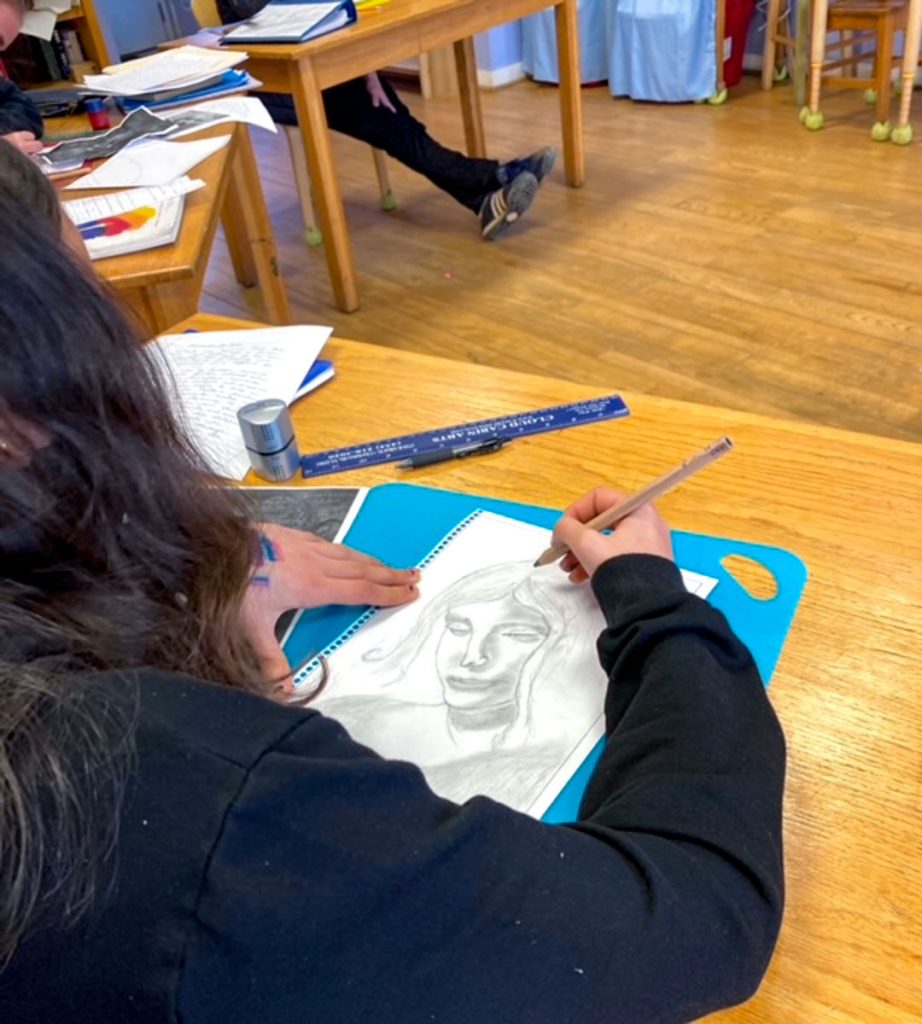
Students listen to stories, practice skills, create artwork, conduct experiments, play music, and participate in meaningful discussions without the constant pull of notifications, hyperlinks, or multitasking. Over time, they develop the ability to focus on a task, persist through challenges, and engage deeply with their work.
These capacities are valuable not only in school but throughout life.
The abstract from a 2024 report from the National Institute of Health titled “Understanding Digital Dementia and Cognitive Impact in the Current Era of the Internet: A Review” states:
Digital media overuse impacts brain development, especially cognitive and inhibitory control, attention, memory, and reasoning, essential for adapting to dynamic environments. Early exposure to fast-paced media can impair motor skills, spatial awareness, problem-solving, and language learning. Neuroimaging studies reveal that environmental factors like screen usage affect brain networks controlling social-emotional behavior and executive functions. Overreliance on smartphones diminishes gray matter in key brain regions, affecting cognitive and emotional regulation.
Preparing Children for the Future
It may seem counterintuitive, but it is increasingly being shown that some of the most future-ready skills are the most human ones.
Creativity. Adaptability. Collaboration. Empathy. Critical thinking. Curiosity.
Technology will continue to evolve and the tools today’s students use as adults may not even exist yet. Regarding the impact of technology on jobs, the World Economic Forum’s The Future of Jobs Report 2023 states: “Agriculture technologies, digital platforms and apps, e-commerce and digital trade, and AI are all expected to result in significant labour-market disruption, with substantial proportions of companies forecasting job displacement in their organizations, offset by job growth elsewhere to result in a net positive.” This suggests that with increasingly rapid changes in technology, the future may hold many possibilities for students who have the continued ability to adapt and learn, while a focus on learning current technology may not be as helpful long-term. What will remain essential, for a student’s future career and life in general, is the ability to think independently, work with others, solve problems, and approach new challenges with confidence.
By emphasizing these foundational capacities first, Waldorf education aims to prepare students not just to use technology, but to shape the future responsibly and thoughtfully.

A Different Kind of Innovation
Being screen-free at school is not about turning back the clock or condemning the use of all technology or all media. Rather, it is an informed approach to making intentional choices about how children spend their time and where they direct their attention. The ability to understand that distinction – to recognize that a tool can be valuable without being appropriate in every circumstance – is itself the form of critical thinking Waldorf education works to develop in our students, to educate not only competent and ethical users of technology but thoughtful human beings who can evaluate technology’s role in their lives and in society.